Worker task translation — Qatar
A residential front-desk role in Qatar runs roughly QAR 4,000–7,000/month (front-desk salaries in Doha average ~QAR 7,700; residential-building roles sit at the lower end). If one receptionist spends ~2.5 hours of every shift re-explaining and translating tasks to workers who can't follow written English, that's about a third of their day — call it QAR 1,500–2,000/month of that one person's time on manual translation alone.
But that's per desk. Reception is staffed around the clock, so a busy tower runs 3–4 people across shifts, and a management company typically runs several towers. Worked example: a firm managing 4 towers with 24/7 reception is carrying that translation load across ~12–15 staff — realistically QAR 20,000–30,000/month of paid time spent being a human translation layer, before you count the harder cost: jobs sitting idle until someone free can explain them.
And none of that counts the most expensive failure of all — the misunderstanding. When a worker half-follows a translated-by-hand instruction and does the wrong thing — wrong unit, wrong part, wrong fix — the job gets done twice: the callout, the parts, the technician's time, and a tenant who's now waited days for a repair that should have taken hours. One accurate translation up front is far cheaper than one redone job. That cost never shows up on a payroll line, which is exactly why it's the one most worth removing.
One tap replaces all of it, and work starts when the job is dispatched, not when a translator is available. Indicative figures; every portfolio differs.
The technicians who actually fix things in Doha often can't understand English instructions fully — enough for small talk, not enough to safely follow a written job scope — so today someone at reception explains or translates every task by hand before work can start. PMFriend removes that step.
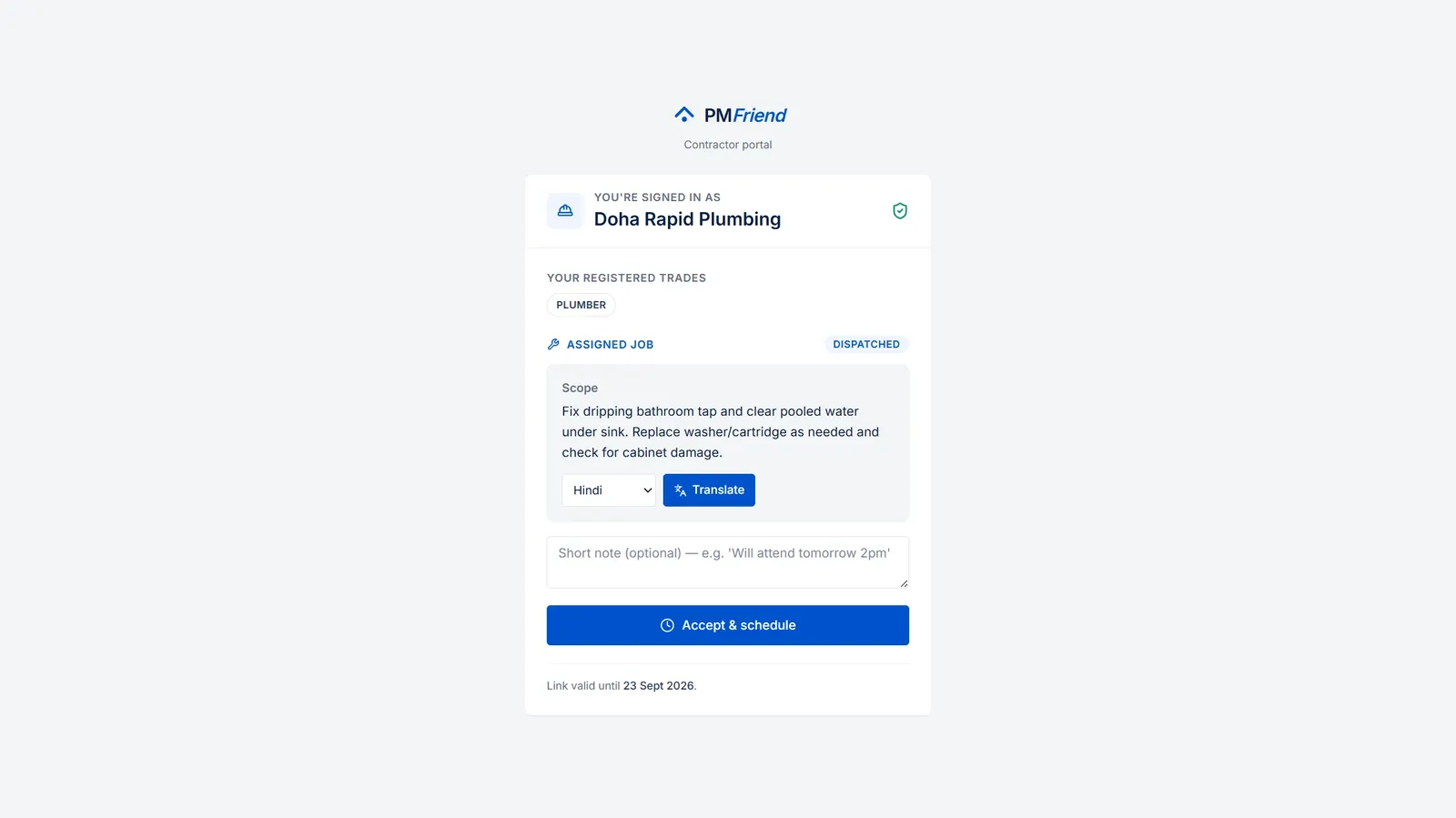 What the worker sees: their job link opens to the scope, a language selector (Hindi, Urdu, Malayalam, Tamil, Bengali, Nepali, Tagalog, Sinhala, Arabic, Ukrainian, Russian), and one Translate button. No app, no login.
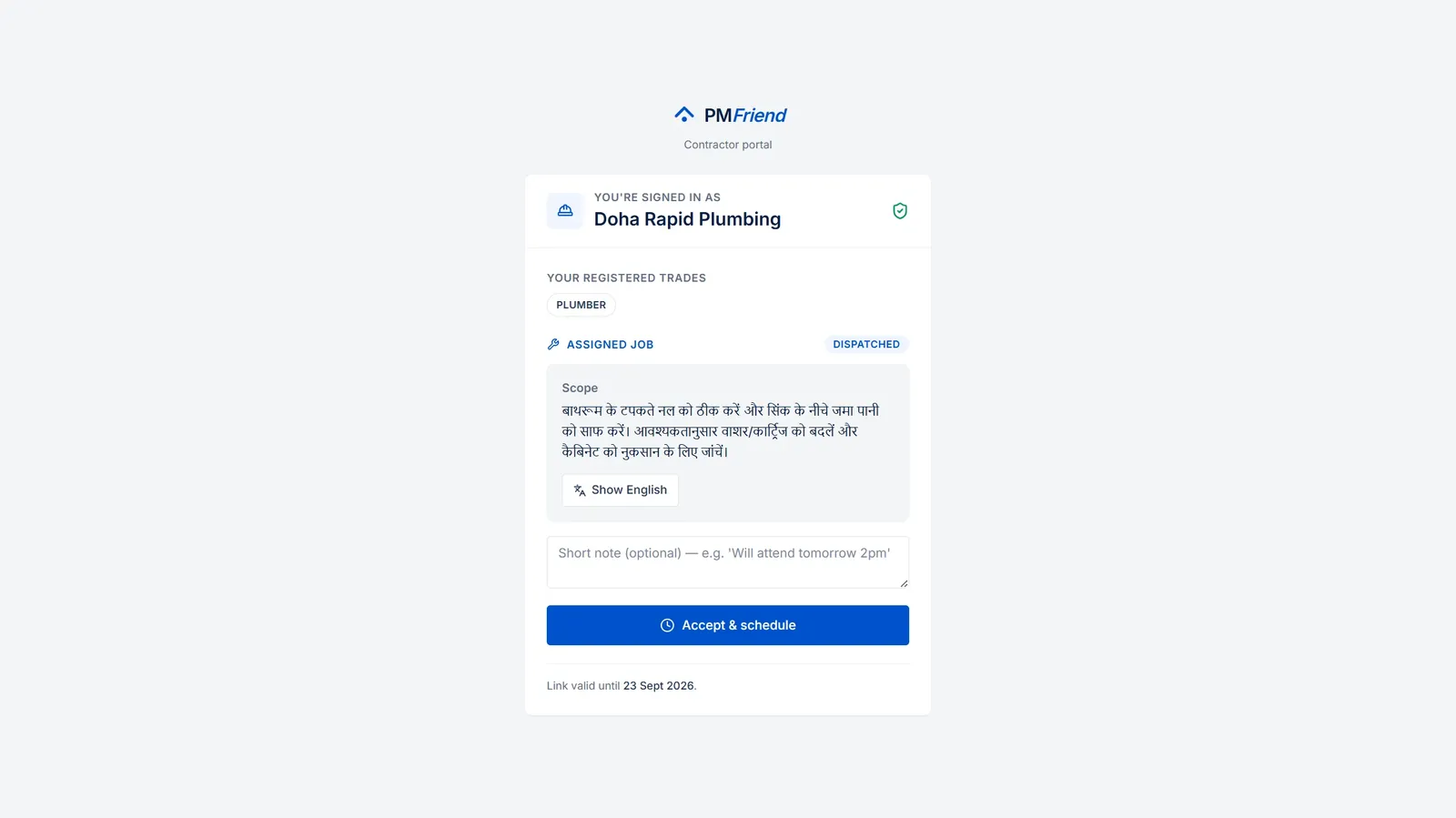 One tap later: the exact same scope in Hindi. "Show English" flips back for cross-checking part names.
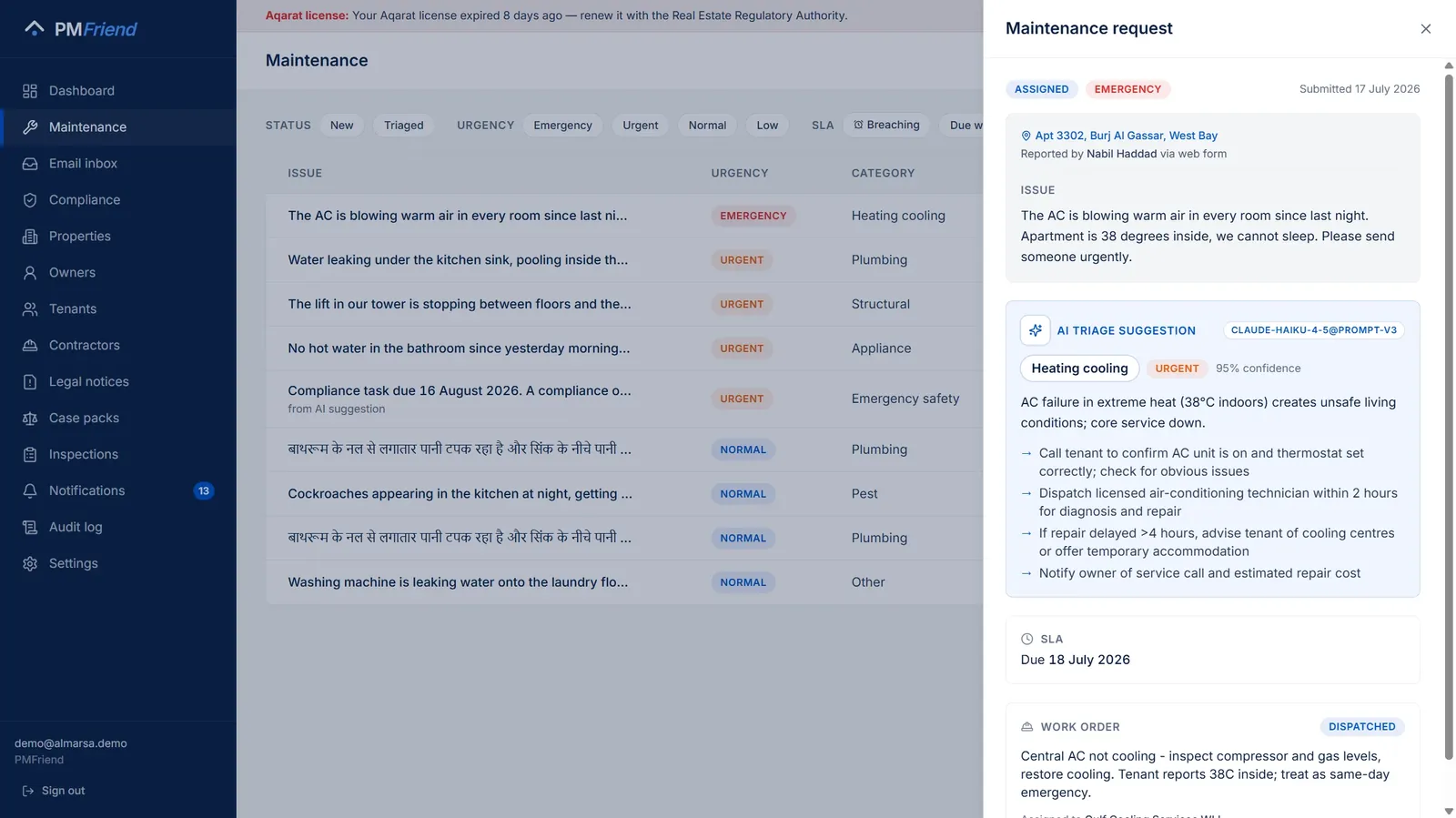 It works inbound too: this tenant reported a bathroom leak in Hindi, and it sits in the queue triaged like every other request.
When you dispatch a job, the worker opens their job link (no app, no login) and sees a language selector: Hindi, Urdu, Malayalam, Tamil, Bengali, Nepali, Tagalog, Sinhala, Arabic, Ukrainian, Russian. One tap and the job instructions render in their language — Arabic and Urdu correctly right-to-left — with a toggle back to English any time.
Three things make this trustworthy rather than a gimmick:
- It translates exactly what you dispatched — same content, same length, nothing added or invented. The instructions the worker follows are the instructions you approved.
- It never guesses. If translation is unavailable, the page shows the original English and says so — a worker is never handed a wrong translation silently.
- Nothing to install or configure. It's on every job link, for every contractor, already.
The receptionist stops being the triage bot; the worker reads the job in the language they think in.
See also
- Contractor management → — the dispatch flow this lives in
- Compliance tracking — Qatar →