Service-charge ledger — Qatar
Every "explain this bill" call with an overseas owner is 30+ minutes across time zones. A ledger that answers first cuts those calls — and transparency is what keeps foreign landlords: retaining one 10-unit owner protects roughly QAR 40,000+/yr in management fees. There's a legal angle too: Qatar's Civil Code (arts. 884–900) apportions common-property costs by ownership share — when an owner challenges their share, a clean per-category ledger IS your answer. Indicative figures; every portfolio differs.
A management company bills one number:
Service charges 2027: QAR 14,500
For an owner living in Germany with an apartment in Doha or Lusail, that number answers nothing. How much went to security? Was the lift actually maintained? Did the reserve fund grow? Why is it 20% more than last year? Is the management fee reasonable? They can't walk downstairs and ask — they depend entirely on the management company's word.
The service-charge ledger turns that number into a record an owner can read:
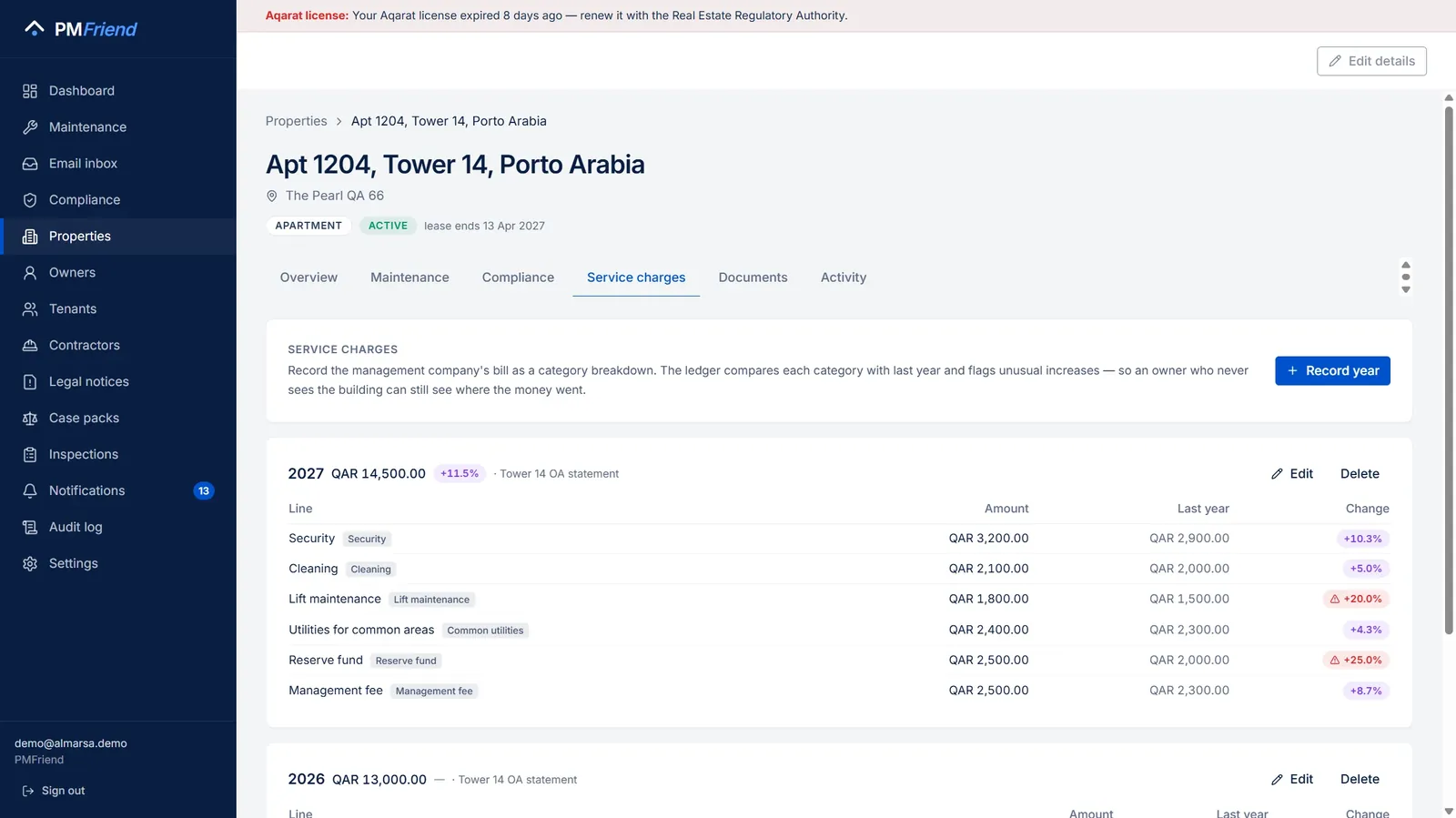 Where to find it: Properties → open a property → Service charges tab. The +20% lift-maintenance and +25% reserve-fund jumps are flagged automatically.
| Line | Amount |
|---|---|
| Security | QAR 3,200 |
| Cleaning | QAR 2,100 |
| Lift maintenance | QAR 1,800 |
| Utilities for common areas | QAR 2,400 |
| Reserve fund | QAR 2,500 |
| Management fee | QAR 2,500 |
| Total 2027 | QAR 14,500 |
What the ledger does
- Category breakdown per year — the PM records the management company's bill line by line on the property's "Service charges" tab.
- Year-on-year comparison, automatically — every category shows last year's amount and the percentage change. Comparison is by category, so it still works when the management company renames its line items.
- Unusual increases flagged — any category up more than 15% on last year gets a visible warning. A quiet 20% jump stops being quiet.
- Amounts in your currency — QAR for Qatar agencies, automatically.
The legal picture (stated carefully)
Qatar's Civil Code (articles 884–900) does regulate common parts of buildings, cost apportionment by ownership share, and owners associations. But the system isn't standardised in the detailed way Germany's WEG regime or Dubai's strata regulation is — practice varies significantly by developer and complex. Some communities, like The Pearl, already run annual owner approvals, reserve funds, and external audits; many towers don't.
That's exactly the gap this feature addresses: service-charge transparency remains inconsistent across Qatar's residential towers, and a clear owner ledger with expense breakdowns and year-on-year comparisons is a real differentiator for foreign landlords. The product doesn't replace the law — it gives a remote owner control over their money and property from a distance.
What's next for the ledger
Attach contractor invoices and completion documents to individual lines, show the owner's share for co-owned assets, and surface the ledger in the owner digest.