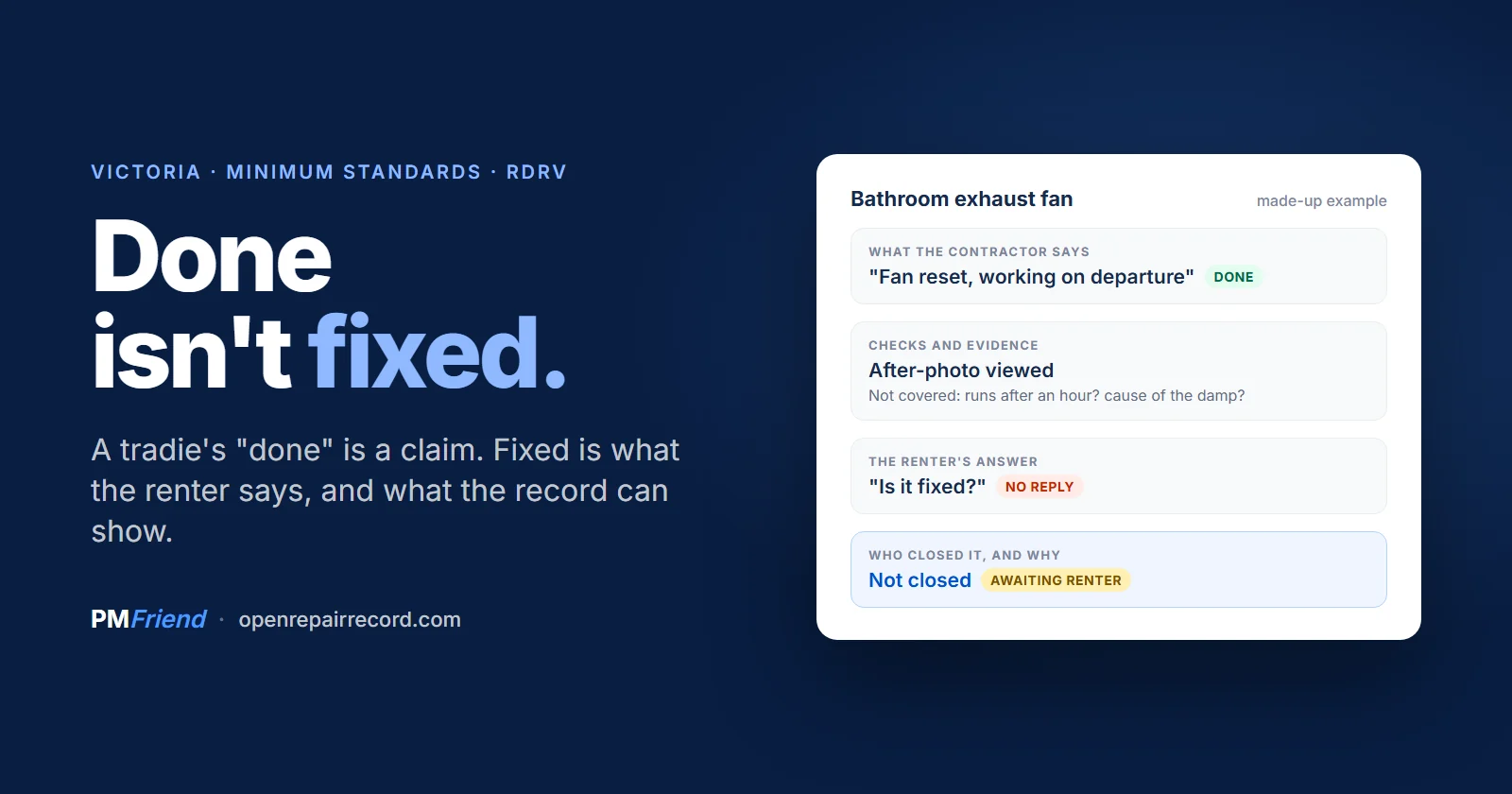
(A made-up example.) It's a Tuesday. The tradie texts "all done" about the bathroom exhaust fan at a two-bedroom unit in Clayton. The job is marked completed and drops off the list.
Three weeks later the renter lodges a dispute with Rental Dispute Resolution Victoria. The mould on the ceiling is back, the fan was reset rather than replaced, and she says she told the agency it still wasn't working.
The agency's file says completed. It doesn't say who checked the fan, whether anyone asked the renter, or what "done" covered. In front of a dispute officer, that's one word against another.
This is the gap between done and fixed, and in Victoria it is getting more expensive.
Why it matters more in Victoria now
Minimum standards are repairs, not paperwork. Rentals with agreements from 29 March 2021 must meet the rental minimum standards. They cover locks, bins, toilets, bathrooms, kitchens, laundries, structural soundness, mould and damp, ventilation, electrical safety, heating, lighting, windows and window coverings. Some arrived later:
- a fixed, energy-efficient heater in the main living area and switchboard safety switches, from 29 March 2023;
- anchored cords on corded blinds, from 1 December 2025.
A property that doesn't meet the standards counts as an urgent repair, and urgent repairs must be done immediately. Non-urgent repairs have 14 days from the renter's written request. [1][2]
Advertising a non-compliant rental is now an offence. Since 25 November 2025 a rental provider or agent may not advertise or offer a property that doesn't meet the minimum standards. Letting a renter move into one was already a criminal offence. The Victorian Government gives maximum penalties of more than $11,000 for individuals and up to $59,000 for companies. [1][3]
The Renting Taskforce is inspecting. Since 2024 it has issued more than 80 fines worth over $670,000. The offences include breaching the minimum standards, failing to advertise at a fixed price and not lodging bonds. [3]
Disputes are cheaper to start. RDRV opened on 23 June 2025 as a free service within VCAT for disputes about bonds, compensation, repairs and rent increases. It is now the first step for most repair disputes. A renter can also arrange an urgent repair of up to $2,500 themselves and claim it back: they send written notice within 7 days of the repair, and the rental provider then has 7 days to pay. [2][4]
And silence is not satisfaction. In a national survey in 2025, 68% of renters said they feared a rent rise if they asked for a repair. [5] A renter who doesn't complain may simply be waiting for a better moment, such as a dispute.
Put together, the question is no longer only "did we send a tradie?" It is "can we show what happened, who checked it, and what the renter said?"
The problem: one "done" box
Most systems close a job with a single status. That status mixes three different things:
- what the contractor says they did;
- what someone checked, if anyone did;
- what the renter says.
When they collapse into one tick, the record can't tell a confirmed fix from a tradie's claim. It also can't tell a renter who said "yes, all good" from one who never answered.
A record in six parts
Open Repair Record is a free, open guide to writing a repair completion record (openrepairrecord.com, CC BY 4.0). It splits the record into six parts. Here they are with the Clayton fan as the example:
| Part | What goes in it | The fan, written properly |
|---|
| 1. What was reported | Where, when, the symptom in the reporter's words | "Bathroom fan not working for a week, mould on the ceiling" (renter, by message, 2 Sep) |
| 2. What the contractor says | Who did the work, what they did, what they claim, what's left | "Fan reset and cleaned, working on departure. Mould treated. Replacement fan quoted" |
| 3. Checks and evidence | Who checked, how, what they found, what the check didn't cover | PM viewed the after-photo; fan running in the video. Not covered: whether it runs after an hour; cause of damp |
| 4. The renter's answer | Resolved, not resolved, not asked, waiting, no reply | Asked 4 Sep: "Is it fixed?" No reply |
| 5. Who closed it, and why | The person, the reason, what still needs following up | Not closed: awaiting the renter; replacement quote sent to the owner, due 18 Sep |
| 6. Later additions | A late reply, a revisit, a correction, added rather than rewritten | 23 Sep: renter reports the fan stopped again and the mould is back. Reopened, revisit booked |
That record doesn't make the agency look perfect. But it is honest and dated, and it shows the agency acted. That is what a dispute officer, a taskforce inspector or an owner asking "why are we paying for this twice?" needs to see.
Five rules that hold up
- Keep each source separate. The contractor's statement, a check and the renter's answer are different entries. Say who said what.
- No reply means no reply. Never turn silence into "resolved", however long it lasts.
- A temporary fix is not a fix. If something is left, it gets an owner and a date.
- Say what a check didn't cover. "Fan running on departure" is not "ventilation adequate".
- Add, don't rewrite. A reopening is a new entry. The history is what shows a repeat fault.
A photo helps, but it isn't required, and a record is not a compliance certificate.
What to change on Monday
- Ask one question after every job: "Is it fixed? Reply 1 for yes, 2 for no." Record the answer, or "no reply".
- Don't close minimum-standard repairs on the tradie's word. Mould, heating, locks, ventilation and electrical safety jobs stay "contractor says done: awaiting renter" until the renter answers or someone checks.
- Keep the dates that matter: when the urgent call came in, when the written request arrived (the 14-day clock starts then), and when the tradie attended.
- Before you advertise or re-let: check the property's open repairs against the minimum-standard categories. Since 25 November 2025 that check protects the agency, not only the renter.
- When a fault comes back, reopen the same record. Three "completed" jobs on one fan in six months are a replacement, not three repairs.
Done is a claim. Fixed is an answer.
A tradie saying "done" is useful information. It just isn't the end of the job. In Victoria, the end of the job is a record that separates the claim from the check and the renter's answer, and keeps the dates.
The guide, a blank template and five worked examples (a temporary fix, a renter who never replies, a fault that comes back, a visit with no access) are free at openrepairrecord.com. Use them with whatever property management software you already run.